
What Banks County Deed Records Contain
The Banks County Clerk of Superior Court serves as recorder for real-estate instruments. Warranty deeds, quitclaim deeds, security deeds, cancellations, liens, plats, and related filings all pass through this office. Know the instrument type before drawing any ownership conclusion.
| Deed Type | What It Does | Common Use |
|---|---|---|
| Warranty deed | Conveys the described interest with stated warranties | Ordinary purchase transfers |
| Quitclaim deed | Conveys whatever interest the grantor holds | Interest cleanup or family transfer |
| Security deed | Secures repayment rather than documenting an ordinary sale | Georgia property financing |
| Executor deed | Conveys through estate authority | Probate transfer |
| Plat or correction | Maps a tract or corrects an earlier record | Subdivision and indexing context |
One search can return a lien, a release, a cancellation, and a transfer deed side by side. Only the instrument's own text tells you what it actually did, and recording proves filing, not the absence of competing interests.
Use the Homer Real-Estate Counter
The Clerk's Real Estate and UCC counter sits at 144 Yonah-Homer Road, Homer, GA 30547. County sources list 706-677-6240, a Clerk line at 706-677-6241, and weekday hours of 8 a.m. to 5 p.m. Stop by when an online deed index skips a date, an image sits behind a paywall, or a certified copy of a deed is what you need.
Banks County dates to 1858, and Homer, once tied to New Lebanon, grew into the seat where deed records and other property records gather. That history explains why the paper trail converges on Homer even when the land itself carries a Baldwin, Lula, or Maysville mailing address.
Compare GSCCCA With Kofile Access
The GSCCCA search opens statewide routes to the Real Estate Index, PT-61 filings, liens, plats, and UCC records. Premium tiers add address, map, date, and instrument filters. The Clerk also links Kofile. Its FAQ spells out the account, subscription, and print-credit requirements.
| Search Key | Purpose | Verify |
|---|---|---|
| Grantor/grantee | Find transfers by party | Role, spelling, tract |
| Book/page | Retrieve a known filing | County and type |
| Date | Narrow a period | Recording versus execution |
| Instrument type | Separate deed, lien, release | Actual text |
The captured Kofile county search screen shows the vendor doorway linked by the Clerk.
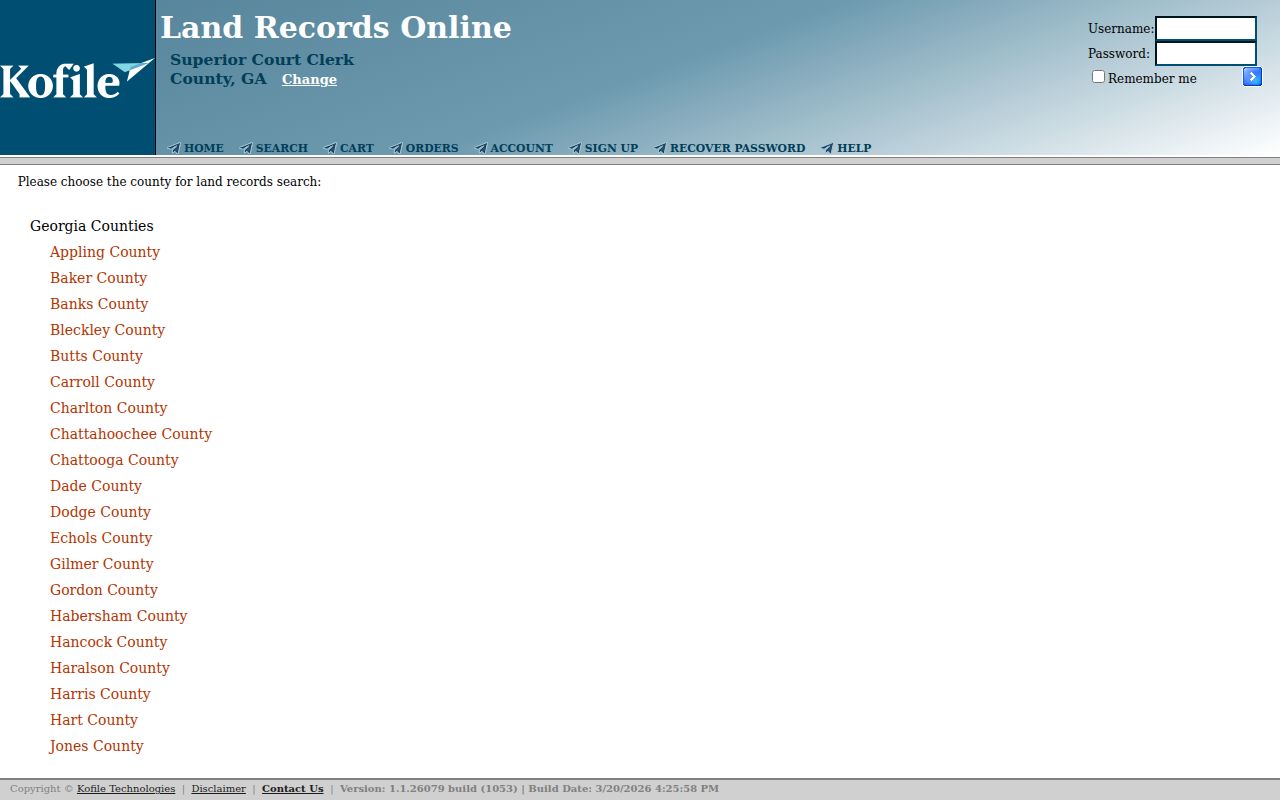
The screen does not establish complete image coverage or an earliest online year.
Walk the Banks Grantor-Grantee Index
Start with the newest deed tied to the parcel. Use each transfer as a bridge to the one before it, and match legal descriptions closely, because one party can hold several tracts.
- Find the apparent current owner's acquisition deed with that party as grantee.
- Read the grantor, legal description, recording reference, and cited plat.
- Search that grantor as an earlier grantee and match the tract.
- Repeat, shifting to books, microfilm, or archives when online coverage ends.
- Grantor
- The party conveying the stated interest.
- Grantee
- The receiving party.
- Chain of title
- The linked conveyances for one tract.
- Book/page or instrument number
- The filing's retrieval reference.
The Banks Online Cutoff Remains Unverified
GSCCCA went operational statewide on January 1, 1999. That start date does not fix when Banks County's own online deed coverage begins. Ask the Clerk where images end. Keep indexed, imaged, and book-only material in separate mental piles. The Georgia Archives county-film search, FamilySearch, and the Clerk can push an older chain further back. Archives lists Banks Ordinary Minutes for 1859-1879, Probate Accounts for 1904-1908, and returns and vouchers for 1917-1936. Such records can explain an estate-related break in title. They never replace the deed itself.
Match the Conveyance With Its Plat
A deed may cite a subdivision, phase, lot, block, acreage, land lot, district, or an older book and page instead of a modern address. Pair it with the GSCCCA Plat Index. Search the Clerk's plat records as well. Local minutes naming The Oaks Phase IV, Oakwood Drive, Maple Drive, and B77 012 are search leads. They are not proof a final plat was recorded. Compare the recorded stamp against the legal description, and remember that GIS can locate the tract while its displayed parcel line is never the legal boundary.
Use FANS for New Filing Alerts
The Filing Activity Notification System sends free, forward-looking alerts about new matching real-estate filings. It watches ahead, not behind. An alert can flag a surprise filing after enrollment. It is no historical search and no title opinion, and its official terms, which bar harassment, limit alerts to lawful property protection, so check any notice against the actual instrument.
Read Every Recording Reference
A complete note on a Banks County deed record names the county, the grantor and grantee, the deed type, execution and recording dates, book and page or instrument number, and the tract description. Preserve subdivision, phase, lot, block, land lot, district, section, acreage, road, and prior-record references. These details separate a relevant conveyance from another filing under the same name.
Older deeds rarely carry a modern situs. Work backward through the references each deed incorporates. Compare acreage and adjoining-owner calls as you go. Pull any cited plat and earlier deed before trusting a broad name match. Separate execution from recording, too. Parties often sign well before filing, and the assessment roll can lag behind both.
After a recent closing, the newest recorded conveyance can outrank qPublic's owner label. Banks County sets no fixed number of days for that update.
Resolve Liens, Releases, and Corrections
The Real Estate and UCC office indexes far more than transfer deeds. Security deeds, assignments, cancellations, liens, releases, easements, corrections, and plats share the same books. A cancellation may only unwind financing. It does not convey the tract. A correction, likewise, repairs a name or description without representing a new sale.
Build an inventory in recording-date order. Label each filing by function. Match every security deed to a later cancellation or assignment. Pair each corrective deed with the instrument it amends. If quiet-title, partition, or foreclosure litigation matters, use Georgia Courts eAccess and the Clerk's court room. Then confirm whether an operative judgment or deed reached the real-estate records.
A docket alone never proves title changed. The recorded instrument, matched to its legal description, still settles the question.
Obtain a Banks County Deed Copy
Ordering a deed copy from the Banks County Clerk of Superior Court starts with a solid reference. Record the county, party names, document type, date, and the book and page or instrument number. That reference saves time. For online access, GSCCCA vendors charge $29.95 per calendar month for premium access, $5 for four consecutive single-use hours, and $0.50 per printed page. Verify current terms before purchase. Banks County publishes no official copy-fee schedule, so ask the Clerk directly about plain-copy, certification, research, mailing, and terminal costs. Ask before you pay. If a record exists but cannot be obtained through these channels, file a focused Georgia Open Records Act request under O.C.G.A. §50-18-70 et seq.
Recorded, not guaranteed. Banks County deed records show filed instruments. An index entry is not a title opinion, and a professional title examination may be needed.
A mail or counter request works best when it names the parties, the document type, the recording reference, and your return address. Say whether you want certification. Ask if prepayment applies. When the copy arrives, compare it against the index reference. Keep both records together. An illegible image deserves a fix, not a guess. Ask the record room staff for the best available scan or the original medium rather than filling gaps by assumption.
Before ordering, scan the index for related instruments recorded near the same time. Conveyances travel in packs. Nearby filings tell the fuller story. One deed may cite a plat, a prior deed, a security deed, or an easement. A corrective instrument may answer your real question faster. Record both dates. The execution date and the filing date can differ. A sequence built only on signatures may not match the Clerk's recording order. Dates reveal priority.
Older Banks County deed records may live in several places. Start with the electronic index. Then ask whether the book you need is imaged, viewable at a public terminal, or held in the record room. Ask if it is reproduced on microfilm. The Georgia Archives county-film collection and the FamilySearch catalog can locate historical series. The Banks County Public Library and statewide library history resources add newspapers and local context. Context helps. It still does not replace the recorded conveyance. Estate gaps deserve special care in Banks County deed research. Ordinary minutes, probate accounts, annual returns, vouchers, wills, and administration papers. Those often explain why an heir, executor, or administrator appears in the next instrument. The Archives holds Banks Ordinary Minutes beginning in 1859, along with probate series reaching into the twentieth century. Use those records to pin down authority and names, then reconnect the chain to the deed books. A death record alone transfers no title.
Plat searches need their own notes. Keep the subdivision name, phase, lot, block, geographic filters, book and page, recording date, and image status together. Phase labels matter. The Oaks Phase IV references in local planning records show how a phase label distinguishes one filing from another. A deed for one lot often incorporates the plat. It does not repeat every dimension, restriction, road, or common-area reference in its own text. Similar names cause trouble in the index. Separate parties with the parcel's acreage, road, adjoining owners, map-and-parcel identifier, prior-record citation, and spouse or entity wording. Try spelling variations too. Search initials, company suffixes, trust names, and estate styles, but never bridge a gap on name similarity alone. Every link in the chain must land on the same legal tract. Preserve the source and retrieval date with every copy. Portal pricing, access rules, and image availability change. A saved index screen shows how you found an instrument, while the Clerk's certified copy supplies the official reproduction when certification matters. For complex ownership, priority, or encumbrance questions, take the complete document set to a Georgia attorney or title professional.